The Icon of Status – The ‘Pajero Culture’
Preparing for the return whites of his eyes. As a visit to Kashmir House in Islamabad nearly twenty years ago showed me, the ultimate sign of authority isn’t Indian ambassador cars of old – it’s fleets of luxury Pajeros. A local journalist aptly dubbed it the “Pajero culture” — a term that perfectly captured the elitism and disconnect of the political class governing Pakistan-administered Jammu & Kashmir (POJK).
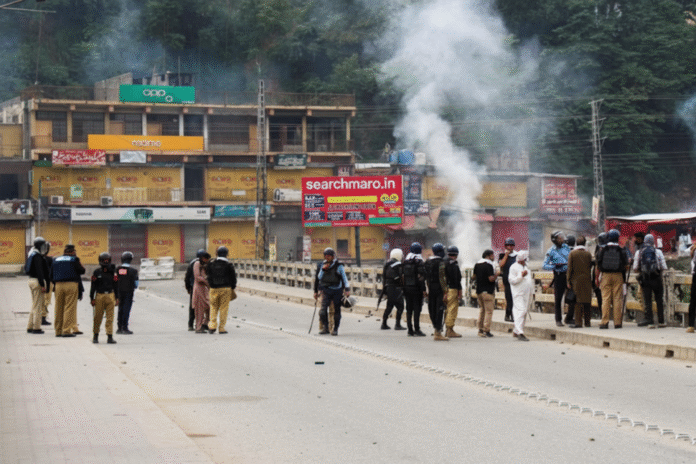
For decades, Pakistan had shown POJK to the world as a quasi-independent state with its own constitution, Prime Minister and President. But recent violent protests have burst this bubble, revealing an intense fight to overcome a political structure that values Islamabad’s influence more than local responsibility.
The ‘Pajero culture’ is no longer merely an emblem — it’s the focal point of a grassroots uprising seeking justice and change.
The Spark: Economic Resentment and a Populist Mobilization
The recent turmoil that has claimed a number of lives and a communications shutdown is led by the Jammu Kashmir Joint Awami Action Committee (JKJAAC).
Formed in 2023, this grass-roots coalition of traders, lawyers, students and porters has tapped into growing public outrage over economic mismanagement and elitism.
Their demands include:
- Short term economic assistance: subsidised electricity and wheat prices, along with the rest of Pakistan.
- An End to Elitism: No more lavish ministerial perks and bureaucrat allowances.
- Structural Reforms – revamping the governance and constitutional setup that disempowers the local population.
Although the authorities insist they’ve fulfilled these demands, JKJAAC contests this, resulting in a deadlock and ongoing protests.
But these protests aren’t solely about the cost of flour — they echo a more profound political grievance entangled in POJK’s political organization.
The Real Fight: Behind the ‘Refugee Seats’ Scandal
Central to the protests is to scrap the 12 ‘refugee seats’ in the POJK Parliament.
These seats are a constitutional abberation and, say detractors, the primary mechanism Islamabad has to control provincial politics.
Here’s why they are controversial:
- They Aren’t Local:
These seats are dedicated to overseas citizens from Indian administrated Jammu and Kashmir (1947). Nine of these 12 constituencies lie beyond POJK, primarily in Pakistan’s Punjab province. - They Are Disproportionate:
There are 373,652 voters for six seats for JM’s — and only 29,804 voters for six for KM’s — a tremendous imbalance. - They Enable Control:
Historically, Islamabad’s ruling party wins most of these seats, ensuring a friendly government in Muzaffarabad.
For instance, in the 2021 elections, Imran Khan’s PTI took 75% of these seats, wresting control of the area.
Instruments of Control: Beyond the Ballot Box
The refugee seats play into a bigger centralized control system.
The POJK Council, chaired by Pakistan’s PM, controls judicial, bureaucratic and financial appointments, as well as natural resource management.
Further, POJK’s constitution imposes harsh “redlines” — mandating that all candidates swear by Pakistan’s ideology, silencing pro-independence voices.
This arrangement means that you get only Islamabad-approved politics, pushing out the real local representation.
A Quick Caveat: Why This Isn’t a Pro-India Movement
It’s simple to mistake these protests as a pivot to India, but that couldn’t be farther from the truth.
The region’s bonds — ethnic, linguistic and trade — are with Pakistan’s Punjab province, not the Indian-administered Kashmir Valley.
The protests are an indigenous push-back against elite capture, and corruption, and disenfranchisement — not a geopolitical realignment.
Though officials are quick to brand dissent as “India-sponsored” to stifle legitimate grievances, the movement is as local and democratic as it gets.
The Road Ahead: A Call for Accountability
The Pajero culture that once delineated POJK’s elite is under historic siege.
The movement is not a rebellion against Pakistan, it’s a call for dignity, fairness and accountability.
Though it’s uncertain what effect it will have, there’s no question —
the people of Pakistan-administered Jammu & Kashmir are no longer content with being spectators.
They’re taking back their destination.