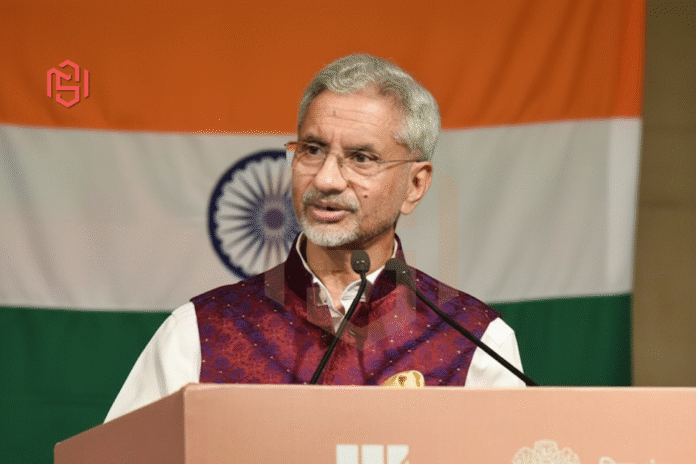
External Affairs Minister S. Jaishankar calls for a balanced India-U.S. trade deal that respects New Delhi’s red lines. Speaking at the Kautilya Economic Conclave, he criticized “unfair” U.S. tariffs and stressed the need for a practical, mutually respectful agreement.
India-U.S. Relations: The Quest for a Fair Trade Deal
In a candid take on the India-U.S. relationship, External Affairs Minister S. Jaishankar said on Sunday that though a trade deal with US is a must, any deal has to honor New Delhi’s core interests and inerasable ‘red lines’.
Addressing the Kautilya Economic Conclave, the minister admitted to the “strain” in the bilateral relationship, largely due to failure to conclude a trade deal and Washington’s ensuing ‘very unfair’ tariffs.
The Quest for a “Landing Ground” — The Test of the National and Necessity
Minister Jaishankar’s also spelled out a realistic negotiating strategy. He stressed the tactical benefit of a trade agreement with the U.S., dubbing it “the world’s biggest market” and pointing out “the rest of the world has these agreements.”
But this necessity does not imply that India will take any deal.
‘It has to be something where our bottom lines, our red lines are respected,’ Mr Jaishankar said emphatically. There are things you can and cannot negotiate in any contract.”
He assured me that they are actively working to find a ‘landing ground’–a compromise of sorts–and have been in discussions since March.
The Source of Stress – Decoding the “Unfair” U.S. Tariffs
External Affairs Minister hit straight at the relationship’s sore spots — citing two rounds of tariffs from the Trump administration that have stressed ties.
General trade tariffs: Broad duties, allegedly up to 50% on some items, were imposed on India as a result of the impasse on the trade agreement.
Targeted Energy Tariffs: A second, additional 25% tariff has been imposed specifically targeting India for sourcing crude oil from Russia.
Mr. Jaishankar was especially scathing about this second step, one that New Delhi has called “unfair, unjustified and unreasonable” in public remarks. He emphasized the policy’s hypocrisy, saying, “we consider it very unfair, which has targeted us for sourcing energy from Russia when others have, including countries that currently enjoy a much more adversarial relationship with Russia than we do.”
It also highlights India’s position that it is being unfairly targeted globally for its independent foreign and energy policies.
A Relationship of Two Halves: Damage Control
In spite of the obvious trade tension, the minister warned against seeing the broader bilateral relationship through the prism of these disputes. He emphasized that although there are “some problems and issues” to be worked out, they’re not wrecking the whole partnership.
“I’d really be reluctant to read much more into it than the issues themselves,” he cautioned. “I also want to say a big segment of the relationship is in fact continuing even going as business as usual or in some cases even going over what it was before doing.”
This subtle point is, in my view, an example of a sophisticated form of diplomacy: the art of segregating disputes. And though the trade problems are real and are being negotiated with urgency, collaboration in other key areas—defense, technology, strategic coordination in the Indo-Pacific—is only growing.
Conclusion: Searching for Common Ground
In the end, however, Mr. Jaishankar’s message was one of determined commitment and practical hope. India is eager to resolve its trade dispute with the U.S., but any way forward must include Washington respecting New Delhi’s core interests. In the months ahead, that search for a “landing ground” will be a hallmark of the relationship.