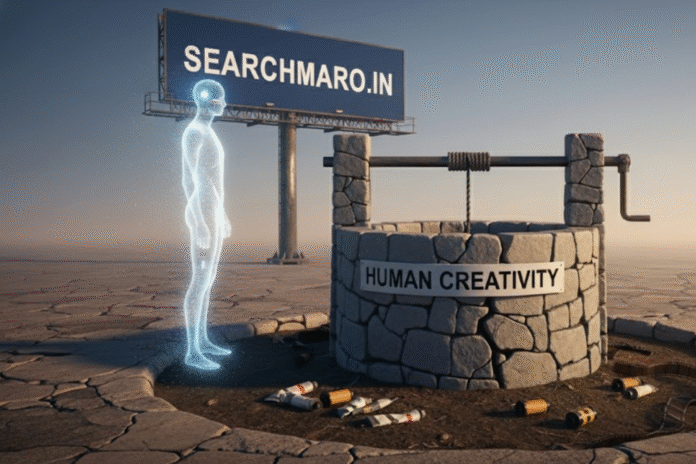
Australia is challenging the AI industry’s use of “free art” for training. Discover why this move to compensate creators is a new blueprint for global AI regulation.
The entire AI industry is based on one, unstated premise — that the sum of human creativity, once posted online, is an all-you-can-eat buffet. Every song, every article, every painting, every book was considered “data” — free firewood to stoke the training of the next wave of machines.
But now, one country has chosen to call out the hijacking.
Australia, a nation not usually perceived as an AI powerhouse, might have just become the sector’s ethical North Star. Last week, it took a clear position on the one most defining question of the AI age – how machines learn, and, even more, whose cost.
The ‘radical idea’ that ignited a flame
The saga begins with a little-known think tank, Australia’s Productivity Commission. In August, it published a report with a hidden, revolutionary notion: a “text and data mining exception.”
In simple terms, this was a plan to grant AI firms a lawful green light to scrape all copyrighted works—books, journalism, art, and music—to train their models without seeking approval and without disbursing a penny.
The commission’s reasoning was practical, if myopic. They maintained that AI requires massive volumes of data to train and that eliminating the copyright ‘barrier’ would allow Australia to get ahead in the global tech race.
But this reasoning overlooks a key reality: AI can’t survive on free art in perpetuity.
Creative Is Not a Raw Material
Not a single dataset behind machine intelligence exists without the shoulders of human creativity. To treat this shared life-work as a free, removable raw resource, like oil or iron ore, is to corrode the culture that renders intellect valuable in the first place.
Understandably, Australia’s creative community responded with outrage. Writers, musicians, and publishers claimed the administration was giving away their livelihoods to Big Tech for free.
The outcry was deafening all the way to the corridors of Parliament in Canberra. Attorney General Michelle Rowland intervened and drew the line.
Australian creatives are not just world class – they are the lifeblood of Australian culture, she continued. Technology’s advance can’t be at their expense!
With that one word, the proposal was canned.
From Extraction to Cooperation, a new blueprint
This wasn’t merely a rejection of their policies – it was an earthquake. Instead of the free-for-all, the government set up the Copyright and AI Reference Group (CAIRG). Its job is to create new licensing arrangements so creators get paid if their work is used to train AI.
This makes Australia the first significant democracy to declare, clearly, that human creativity is not public property simply because it’s online.
This choice makes the AI business mature. The ‘move fast and break things’ days of data scraping are behind us. If AI firms want premium, fresh data (and they desperately do) they will now have to do what every other sector does: negotiate, license, and pay for it.
This isn’t a barrier to innovation. It’s the next step in its development.
Why This is Important for the World (and India)
The AI industry stands at a crossroads.
- Way 1: Go on vacuuming up culture in a legal grey zone, attracting continual lawsuits (as we’ve already witnessed), regulatory crackdowns and gigantic public mistrust.
- Path Two: Build something sustainable. Establish an ecosystem anew where innovation rests on the ground of consent and compensation.
Australia’s shift provides a transparent roadmap for other democracies, such as India, who are also navigating AI regulation. It demonstrates that protecting creators is not “anti-innovation”–it’s the only way for innovation to be legitimate.
And as governments worldwide awaken to this challenge, they have to establish systems to make sure human ingenuity is properly rewarded. The future of AI isn’t just about crunching power, it’s about the humans who teach machines to learn.
And no matter how smart the machines become, they can’t subsist on free art forever.
Frequently Asked Questions (FAQ)
Q1: What is the main issue this article discusses?
The article discusses the AI industry’s widespread practice of “scraping” or “mining” copyrighted content (like books, art, and articles) from the internet for free to train their AI models. It focuses on the ethical and economic problem of creators not being paid for their work.
Q2: What did Australia’s Productivity Commission originally propose?
The commission proposed a “text and data mining exception.” This was a legal free pass that would have allowed AI companies to use copyrighted material to train their models without asking for permission or paying creators, all in an effort to help Australia “catch up” in the global tech race.
Q3: Why was this “free pass” proposal scrapped?
The proposal was met with a fierce backlash from authors, artists, and news organizations. They argued it was a giveaway of their life’s work to Big Tech. The Australian government, led by Attorney General Michelle Rowland, sided with the creators, stating that “Technology’s advance must not come at their expense.”
Q4: What is Australia doing now instead of the “free pass”?
The government has established the Copyright and AI Reference Group (CAIRG). This group is tasked with designing new licensing models to ensure that creators are fairly compensated when their work is used to train AI models.
Q5: Why is Australia’s decision so important for the rest of the world?
Australia is the first major democracy to definitively state that creative work online is not public property for AI training. This action serves as a blueprint for other countries on how to regulate AI. It pushes the AI industry to evolve from a model of “extraction” (taking data for free) to one of “cooperation” (licensing and paying for data), which is seen as more sustainable and legitimate.