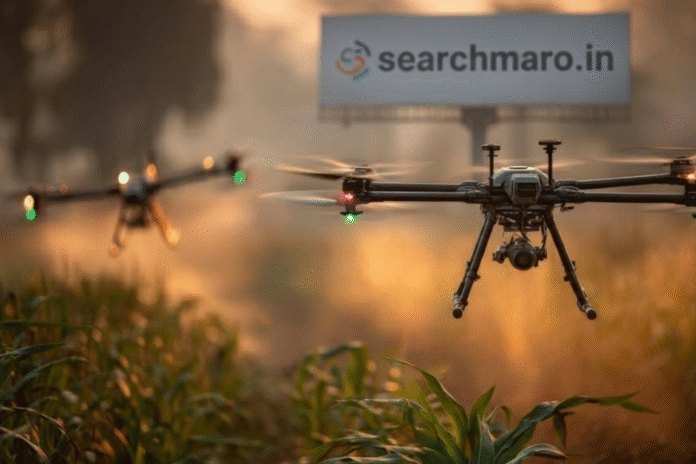
The innovation simplifies drone architecture, enhances stealth, and ensures stability even in dynamic missions.
Novel scheme by IIT Bombay researchers to control drones can enable complex formation flying using only camera data, without GPS or inter-drone communication.
Look, No GPS: IIT Bombay Unlocks Truly Autonomous Drone Swarms That ‘See’ Their Way
Imagine a swarm of drones flying in perfect, coordinated formation. Now, imagine they are doing it with no GPS, no communication with each other, and no central “brain” telling them what to do. They are flying like a flock of birds, with each drone simply observing its neighbors and reacting.
This isn’t science fiction. It’s the result of a new control scheme developed by Professor Dwaipayan Mukherjee and research scholar Chinmay Garanayak at the Indian Institute of Technology (IIT) Bombay. Their breakthrough enables unmanned aerial vehicles (UAVs) to operate in swarms with an unprecedented level of autonomy, a critical leap for the future of robotics.
The Problem with “Standard” Drone Swarms
Most current drone swarm technologies rely on a constant stream of external information. They need one of three things to work:
- GPS: Each drone needs to know its precise global coordinates.
- Inter-drone Communication: Drones constantly “talk” to each other, sharing their position and speed.
- A Central Controller: A single ground-based computer (or human) acts as a puppet master, directing every drone.
The problem? Each of these methods is a critical point of failure. If GPS is unavailable (indoors, in deep canyons, or “jammed” in a military scenario), or if communication is blocked, the entire swarm collapses.
“Autonomy in a swarm is a critical task,” Professor Mukherjee explained. “This means that vehicles… should be able to decide their ‘actions’ based on variables they can measure with their on-board sensors, instead of… some global information… This is where our paradigm differs from usual ones.”
The “Bearing-Only” Breakthrough: How to Fly by Sight
The IIT Bombay team’s solution is both elegant and robust. Instead of GPS or radio signals, each drone uses a simple, low-power onboard camera.
Here’s how it works:
- Each drone in the swarm observes its immediate neighbors.
- It doesn’t need to know how far away they are (a measurement prone to sensor “noise”).
- It only needs to calculate the “bearing”—the direction or angle of its neighbors relative to itself.
Using just this “bearing-only” information, the new control scheme allows each drone to independently decide how to adjust its own motion to maintain the swarm’s formation.
This camera-based method is not only stealthier but also more efficient. It simplifies the drone’s sensor system, which in turn reduces battery requirements and overall weight.
Solving the “Underactuated” Puzzle
The team’s research is even more impressive because they applied it to Vertical Take-Off and Landing (VTOL) UAVs. These are the drones that can lift off like a helicopter and hover, making them perfect for surveillance and operations in tight spaces.
However, VTOLs are notoriously difficult to control. They are “underactuated,” a technical term meaning they have six degrees of freedom (they can move up/down, left/right, forward/back, and rotate on three axes) but fewer direct controls to manage those movements. For example, to move left, a drone must indirectly control its movement by tilting and thrusting.
“Many of the results in the literature do not address the underactuated dynamics of VTOL vehicles,” Mr. Mukherjee noted. His team’s research, however, tackles the full, complex dynamic model (including position, velocity, forces, and torques). They have developed a control mechanism, supported by rigorous mathematical proof, that ensures the swarm can achieve and maintain its desired formation, even if the drones start from imperfect positions.
Flexible Formations for Real-World Missions
The IIT Bombay system is not just for static formations. The researchers have designed it to handle “arbitrary time-varying configurations.”
In simple terms, the swarm can change its shape on the fly. Imagine a swarm approaching a narrow canyon or a gap between buildings. The drones can reconfigure themselves into a single-file line to pass through, then spread back out into a wider formation to continue their mission. This adaptability is critical for real-world applications.
What’s Next? From Theory to Real-World Flight
With the mathematical proof established, the team’s next step is to test the control scheme experimentally on a physical drone swarm.
Their future roadmap also includes tackling the next great challenge in autonomous swarms: collision avoidance. The goal is to move beyond the ad hoc avoidance systems used today and develop a method that comes with “theoretical guarantees”—a provably safe system where drones can avoid each other and obstacles in their environment. This research from IIT Bombay isn’t just an incremental improvement; it’s a foundational step toward a future of truly intelligent and resilient autonomous systems.
Frequently Asked Questions (FAQ)
Q1: What is this new drone technology developed at IIT Bombay?
It is a sophisticated control scheme that allows a swarm of drones (UAVs) to fly in a coordinated formation. The most significant feature is that it works without relying on GPS, inter-drone communication, or a central control system.
Q2: How can the drones fly in formation without GPS?
Each drone uses its own onboard camera to get “bearing-only” measurements. This means it simply observes its immediate neighbors to determine their direction and angle relative to itself. Based on this visual information, each drone autonomously decides how to move to maintain the swarm’s shape.
Q3: What are the main advantages of this system?
This system has several key advantages:
- True Autonomy: Drones make their own decisions based on what they can “see.”
- GPS-Independent: It can be used in areas where GPS is unavailable or jammed, such as indoors, in deep canyons, or during stealth military operations.
- Efficient: Camera-based measurements are less “noisy” than distance sensors, require less battery power, and reduce the drone’s overall weight.
- Stealthy: The lack of inter-drone communication makes the swarm harder to detect.
Q4: What specific type of drone was this tested on?
The researchers applied this scheme to VTOL (Vertical Take-Off and Landing) drones. These are advanced drones that can take off like a helicopter, hover, and are ideal for surveillance in confined spaces.
Q5: The article mentions VTOLs are “underactuated.” What does that mean, and why is it important?
“Underactuated” means the drone has more “degrees of freedom” (ways it can move, like up/down, left/right, and rotate) than it has direct controls. For example, to move forward, it must indirectly control its motion by tilting its whole body. This makes it much harder to coordinate. This research is a major breakthrough because it provides a reliable control system for these complex dynamics, a problem many previous attempts failed to solve.
Q6: Can the drone swarm change its shape while flying?
Yes. The system is designed to handle “arbitrary time-varying configurations.” This allows the swarm to be highly adaptable, such as reconfiguring from a wide formation into a single-file line to fly through a narrow passage and then spreading out again.
Q7: What are the next steps for this research?
The team plans to move from mathematical proof to experimental testing with a real drone swarm. Their next major goal is to tackle collision avoidance (with other drones and the environment) and develop a system with “theoretical guarantees” of safety.