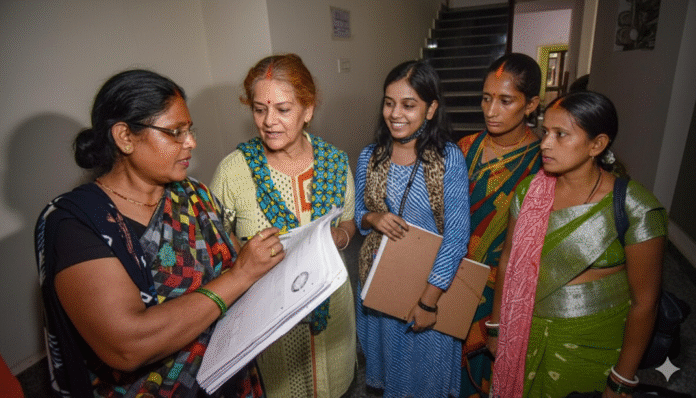
Government school teachers in India are increasingly burdened with non-teaching duties like surveys, election work, and administrative tasks. Explore the hidden cost of these responsibilities on teachers’ well-being, student learning, and the education system.
Karnataka Teachers Under Pressure
As the Dussehra vacation set in last week, close to two lakh public school teachers in Karnataka initiated a gigantic state-wide endeavor. Their job was not to make lesson plans or grade papers, but to undertake the detailed caste census, a door-to-door 60-question survey. And this is not an isolated case, it’s the standard operating procedure for government school teachers throughout India, who are more and more being utilised as a de-facto government bureaucratic work force.
This growing laundry list of non-teaching demands is pushing teachers to the brink, prompting urgent questions about their core mission, professional pride, and the downstream effect on the students they’re supposed to be educating.
A Barrage of Demands Outside the Classroom
As a government school teacher, my daily life is awash with work that transcends the syllabus. Sure election duty is a known, if inconvenient, piece of their job as public servants, but it’s only the tip of the iceberg. The lineup of responsibilities is formidable:
- Massive Surveys: Aside from the caste census, teachers are often called to do the household health surveys and the animal census. The caste census, by itself, as one teacher from Koppal, Karnataka, observed, necessitates at least 10 houses a day for 15 days straight.
- Administrative Overload: Digital systems such as SATS are tedious to maintain and update, all done after school.
- Rudimentary School Administration: Teachers undertake weekly tasting and validation of lunches, home visits to children with irregular attendance, and complicated student support systems such as “buddy pairing” differing abilities.
- Required Training: Beyond this, teachers are regularly yanked out for “Content Enrichment” or “Motivational Training”—brief, usually-hollow workshops forced in response to bad test scores.
As English teacher Shankarappa observes, “it all adds up,” leaving little time or energy for the fundamental educational mission.
The Teaching Gap: What is a Professor’s ‘Actual’ Work
The key lies, as educationist and Delhi University professor Anita Rampal observes, in separating work that is indispensable to pedagogy and that which subverts a teacher’s function.
There’s an obvious distinction between tasks that are intrinsically connected to a student’s life and ones that are purely administrative. “Serving the mid-day meal, evaluating a child’s progress are assignments that are integral to a student’s life,” Professor Rampal contends. These exercises aid a teacher in knowing their students as whole individuals.
By contrast, sending teachers on an animal census or to the opening of a local event is an abuse of their skills. Professor Rampal is critical of the emergence of what she terms “neoliberalist ideas of outcome-based approaches,” such as requiring two days of training to repair bad exam performance. ‘What does a two-day training accomplish?’ she wonders, highlighting how such token efforts merely infuriate teachers and scapegoat blame while ignoring the systemic problem.
The Personal Toll: Health, Respect and Unjust Blame
The ceaseless weight of these peripheral responsibilities takes a serious psychological toll. Sangeeta Sahu, a DIET instructor in Durg, Chhattisgarh, refers to it as a “well-being concern.”
She says, ‘It’s infuriating that a government teacher with an M.Sc and M.Phil needs to go on yet another data collection’.
The truest irony is in the accountability. Teachers are dispatched for months on end on survey or election duty, only to be faulted when their students don’t make the grade. The penalties are harsh, from denied salary hikes to show cause notices and punitive transfers to far flung regions. The students’ results are the evidence. The psychological torture is when the blame for bad results is returned to these instructors,” Ms. Sahu says.
The toll on one’s self can be soul seeking. Ms. Sahu, herself recalls running from pillar to post to get one week relief from duty to undergo cancer treatment. ‘I had to beg the collector to release me,’ she remembers. We’d say, ‘God may pardon you but you’ll never get off government service’.
This bureaucratic apathy is exacerbated by corporeal dangers, as teachers have died while serving election duty in politically volatile areas.
Redesignating the Function and Rehabilitating the Honor
At heart, the problem is about the dignity of labour. Our system now views teachers as a limitless supply of human resources for all and any government assignment. This not only distracts them from their main duty, but it disrespects their professionalism and commitment as professors.
To really reform public ed, lawmakers have to solve this basic dilemma. It needs to move from blaming teachers for bad outcomes to fostering a culture where they are enabled to do what they were hired to do, teach. Returning dignity to the profession of teaching is about respecting their time, honoring their craft, and letting them get back to the students who need them.
Frequently Asked Questions (FAQ)
Why are Karnataka teachers tasked with non-teaching duties?
A1: Government school teachers in Karnataka, like elsewhere in India, are increasingly used as a de-facto bureaucratic workforce. Duties include caste censuses, health surveys, election work, and administrative tasks, in addition to their teaching responsibilities.
How does this affect the teachers’ primary role?
A2: These additional tasks reduce the time and energy teachers can devote to lesson planning, student engagement, and educational support, compromising the quality of learning.
What are some examples of non-teaching duties?
A3: Examples include conducting caste and household surveys, maintaining digital administrative systems like SATS, monitoring mid-day meals, home visits for irregular students, and attending mandatory workshops or trainings.
What is the impact on teachers’ well-being?
A4: The workload can cause psychological stress, health issues, and feelings of professional disrespect. Teachers are often blamed for student performance despite being overburdened with administrative duties.
How can the system improve teachers’ work conditions?
A5: Reforms should focus on reducing administrative overload, respecting teachers’ time, providing adequate support, and allowing them to concentrate on their core mission—teaching. Returning dignity to the profession is key.
Are teachers at risk while performing these duties?
Yes. Teachers face risks such as physical danger during election duties, exposure to volatile situations, and bureaucratic penalties if students underperform academically.
📢 Note to Readers
If you find any mistake or correction in this blog, please let us know.
👉 Contact: correction@searchmaro.in