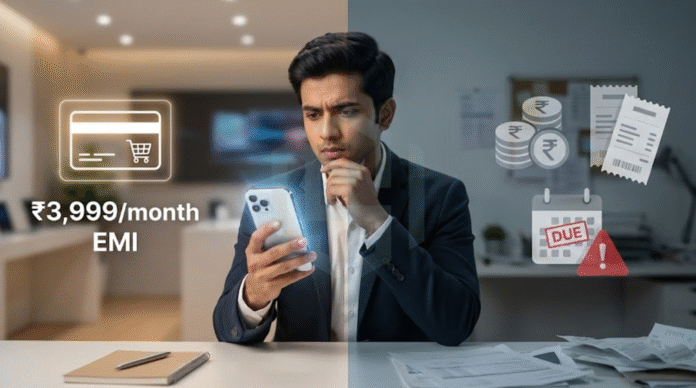
Is buying a smartphone on EMI a good idea? We break down the math, the psychology of debt traps, and a 2-step rule to ensure your next tech purchase is a smart investment.
If you have scrolled through an e-commerce site lately, you’ve seen it: that shiny new smartphone with a price tag that makes your eyes water, but right next to it is a small, tempting button that says “Starting at ₹3,999/month.” In the last few years, Indians have embraced EMI (Equated Monthly Installments) at a crazy level. But a big question remains: Is buying a phone on EMI a smart move or a ticket to a financial nightmare? Finance YouTubers tell you to live like a monk, while tech influencers say, “If you can’t pay cash, you can’t afford it.”
The reality? It’s a bit more complicated than that. Let’s break down the psychology of the “EMI Trap” and how you can use this tool without ruining your life.
The Math: No-Cost vs. Interest-Bearing EMI
At its core, an EMI is just a loan. A bank pays the full amount to the store, and you pay the bank back over time. There are usually two types:
- Interest-Bearing EMI: You pay the price of the item plus a percentage (often 13-16%).
- No-Cost EMI: While it sounds “free,” it rarely is. Between processing fees and GST, a ₹10,000 item can still end up costing you around ₹10,400.
While these small monthly amounts look harmless, the danger isn’t in the math—it’s in your head.
The Psychology of the ‘Debt Trap’
Human psychology is a tricky thing. When we see a ₹1 Lakh iPhone, it feels impossible. But when we see a ₹5,000 monthly payment, our brain says, “I can handle that!”
The pattern usually looks like this:
- You buy an iPhone (₹5,000/month).
- A sale comes along, and you grab a Smart TV (₹3,000/month).
- You decide you need a MacBook for “productivity” (₹7,000/month).
Suddenly, your monthly bill is ₹15,000. If you earn ₹50,000, that’s 30% of your income gone before you’ve even paid for food or rent. This is how “Easy Installments” become a Debt Trap.
The ‘Launch Day’ Trap and Depreciation
One of the saddest parts of tech EMIs is depreciation. In India, nearly 70% of iPhones are bought on EMI. Many people buy them on Day 1 for ₹80,000. Six months later, that same phone is selling for ₹65,000 in a sale.
If you bought it on EMI, you are still paying interest based on the ₹80,000 price tag for a device that is now worth significantly less. You are essentially paying a “status tax” to look good in society.
The 2-Step Checklist for a Smart Purchase
I use EMIs myself to buy gear for my YouTube channel, but I never fall into the trap because I follow two simple rules. If you want to stay safe, ask yourself these two questions:
1. Does this add ‘Value’ to my life?
Value is different for everyone.
- If you are a student learning to code, a MacBook is a value-added tool.
- If you are a filmmaker, a high-end camera is an investment. If the item helps you improve a skill or earn more money in the future, the EMI is often worth it.
2. Is it ‘Feasible’ for my reality?
Don’t get lost in the illusion that you “deserve the best.” If a ₹50,000 camera does the job, don’t buy the ₹2 Lakh model just because it has a lower EMI option. Always check your capacity to pay without stress. Reality-check your desires against your bank balance.
Need vs. Want: The Final Verdict
Internet “gurus” often say, “If you can’t buy it twice, don’t buy it once.” Honestly? That’s hard advice to follow when the average salary in India is ₹30,000.
Instead of following rigid rules, learn the difference between Needs and Wants:
- Needs: Tools that help you grow (Laptop for work, a reliable phone for communication).
- Wants: Things bought for temporary happiness or status (Expensive watches, luxury accessories).
Conclusion: EMI is a fantastic tool for smart people who plan. It’s a trap for those who live in an illusion. If you are honest about what you can afford and why you are buying it, EMI can help you grow. If you’re buying it just to show off, the “Easy” installments will eventually become very hard.
What do you think? Have you ever felt stuck in an EMI loop, or has it helped you get the tools you needed for your career? Let’s discuss in the comments below!
The “Should I Buy It on EMI?” 30-Second Flowchart
Follow the path to see if you are making a smart move or falling into a trap!
START HERE: You see a shiny new gadget.
Step 1: The “Why” Test
- A. It’s a tool for my career/education (laptop for code, camera for content). → Go to Step 2
- B. I just want it because it looks cool/friends have it. → STOP! If you can’t pay cash, don’t buy it.
Step 2: The “Reality” Check
- A. I have at least 2x the cost of the item in my bank account right now. → Go to Step 3
- B. I have zero savings and am relying entirely on next month’s salary. → WAIT! Save up at least a 30% down payment first.
Step 3: The “Affordability” Math
- A. This new EMI + my existing EMIs will be LESS than 30% of my monthly take-home pay. → Go to Step 4
- B. This EMI will make my total debt MORE than 30% of my income. → REJECT! You are entering the Danger Zone.
Step 4: The “Deal” Evaluation
B. It has 15% or higher interest. → ⚠️ THINK AGAIN! Pay in full if you have the cash; otherwise, it’s too expensive.
A. It’s a No-Cost EMI with zero hidden interest. → ✅ SMART BUY! Use the EMI and keep your cash liquid.
| If your situation is… | Your Action Should Be… |
| Buying for Status | Walk Away. No gadget is worth financial stress. |
| Buying for Growth | Green Light. If the math (30% rule) works. |
| Zero Savings | Wait 3 Months. See if you still want it after saving. |
| High Interest Rate | Pay Cash. Don’t give the bank your hard-earned money. |
“Before you hit ‘Buy,’ leave the item in your cart for 48 hours. If the ‘need’ feels just as strong after two days of thinking, and your flowchart result was a ‘Smart Buy,’ go for it. Most ‘Wants’ fade after the first 24 hours!”
Frequently Asked Questions: Mastering the EMI Game
Q1: What is the actual difference between No-Cost EMI and Interest-Bearing EMI?
In an Interest-Bearing EMI, you pay the product price plus an annual interest rate (usually 13-18%). In a No-Cost EMI, the interest amount is typically given to you as an upfront discount by the retailer or brand. However, you still pay the bank the full price over time. While it looks “free,” you are often still charged a processing fee and GST on the interest component.
Q2: Is it always bad to buy a smartphone on EMI?
Not at all. EMI is a tool. It is good if you are buying a device that adds value to your life or career (like a laptop for a student or a camera for a creator) and you can comfortably afford the monthly payments. It is bad if you are buying it solely for social status or if the total monthly EMI exceeds a safe portion of your income.
Q3: What are the “hidden costs” I should look out for?
Even with “No-Cost” offers, keep an eye on:
- Processing Fees: A one-time fee charged by the bank (usually ₹199 to ₹500).
- GST: You have to pay 18% GST on the interest amount calculated by the bank.
- Pre-closure Charges: If you want to pay off the loan early, some banks charge a penalty.
Q4: How much of my monthly salary should go toward EMIs?
Financial experts generally suggest that all your combined EMIs (phone, car, personal loans) should never exceed 30-35% of your take-home pay. For “lifestyle” gadgets like phones, it is safer to keep it under 10-15% so you have a buffer for emergencies.
Q5: Should I take an EMI if I already have the full amount in cash?
If you are getting a true No-Cost EMI, it might be smarter to take it. This keeps your cash “liquid” (available in your bank) for emergencies or allows you to keep that money in a savings account or investment where it earns interest. However, if there is a high interest rate, paying in full is always better to save on interest costs.
Q6: Does buying things on EMI affect my Credit Score (CIBIL)?
Yes. Every EMI is a loan. If you pay on time, it actually helps build a strong credit score, making it easier to get a home or car loan later. But, if you miss even one payment, your score will drop, which can hurt your financial future.
Q7: How do I know if I’m falling into a “Debt Trap”?
You are likely in a trap if:
You have no money left for savings at the end of the month because of your installment bills.
You are taking a new EMI to pay off an old one.
You are buying things you don’t use just because the EMI was “low.”